
Home › Drywall & Paint › Drywall Repair and Texture Matching
Drywall repair.Holes, cracks, water damage and settling, patched and textured to match what is already on the wall.
A drywall repair succeeds or fails on the texture match. OnCall matches knockdown, orange peel, skip trowel and hand textures against the wall as it exists today, including walls that have been painted several times, and feathers the patch wide enough that the eye has nothing to catch on.
The patch is not the hard part
Cutting a clean square, backing it and filling it is straightforward work. Making it disappear is not. A repair that is structurally sound and visibly obvious has failed, because you are going to look at that wall every day and see the place where something happened.
Two things decide whether a patch vanishes: the texture match and the feather. The texture has to be the same profile and the same density as the surrounding wall, and the transition has to be spread wide enough that there is no ridge for side light to pick up. Under a window on a winter afternoon, a one inch feather shows and a twelve inch feather does not.
Matching a texture that has been painted over
Most walls in a lived-in house have been painted at least twice, and every coat softens the texture profile slightly. This is why matching to a texture sample board produces a patch that looks new next to a wall that is not. The match has to be made against the wall as it is today, which means mixing to the consistency that reproduces the current profile rather than the original one.
Common central Indiana textures and how they behave:
- Knockdown. Sprayed, allowed to set, then flattened. The timing of the knock is what sets the profile, and it changes with humidity.
- Orange peel. Sprayed and left. Consistency and tip size do all the work.
- Skip trowel and hand textures. Applied by hand, which means matching a person's motion, not a machine setting.
- Smooth. The least forgiving of all, because there is no texture to hide the transition.
What causes most of the repairs
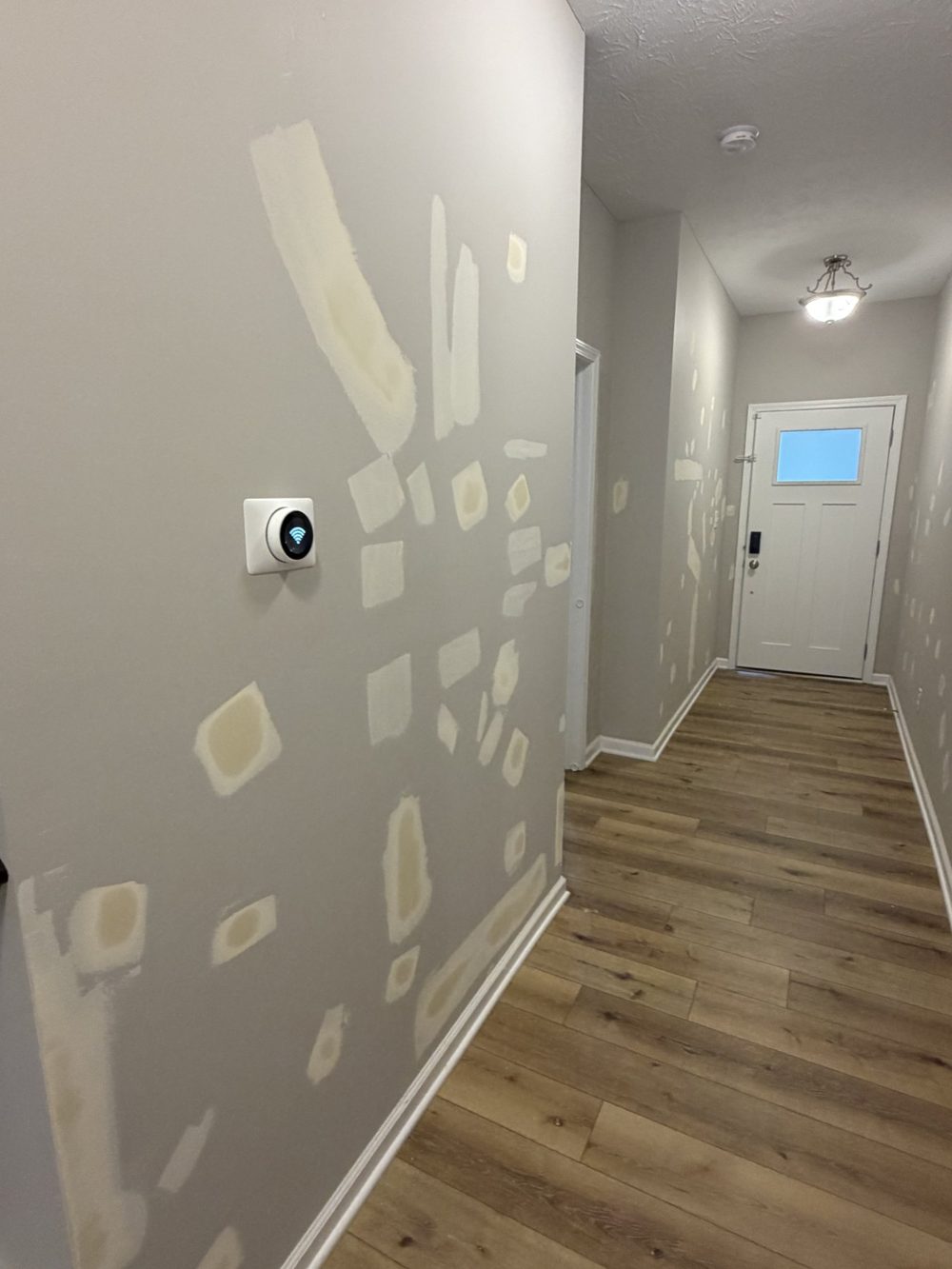
Settling cracks at the corners of doors and windows, nail pops, water damage from a roof or a supply line, doorknob impacts, and the holes left behind when a TV mount or a shelf comes down. Water damage is the one worth calling early, because drywall that stays damp is a mold question and not just a cosmetic one.
How it is quoted
Small repairs are quoted from photos within 24 hours as handyman work. Take the picture straight on and a second one from an angle, because the angle is what shows the texture. Larger areas, ceilings and anything involving water get a look in person.
Repairs are usually paired with paint, because a patched and textured area still reads as a patch until the wall is coated corner to corner.
Frequently asked questions.
Will the repair be invisible?
Once painted corner to corner, that is the standard being worked to. A patched and textured area that has not been repainted will still read as a patch, because new compound and old paint reflect light differently.
Do I have to repaint the whole wall?
For the repair to disappear, usually yes, corner to corner rather than spot painting. Spot painting a textured wall leaves a visible halo.
Can you fix cracks that keep coming back?
A crack that returns is telling you something is still moving. That gets diagnosed rather than filled again.
Do you handle water damaged drywall?
Yes. Cory spent years in insurance restoration on water and fire damage, so this is familiar work.
Ready to price drywall repair and texture matching?
Photos and a short description are usually enough to get a real number back. Larger projects get an onsite consultation and a written itemized bid.
One Call. We Handle It All.